 Jackson's Space
Modernizing Sample Requests
Designing a scalable workflow that replaces thousands of manual supplier spreadsheets with an integrated system inside Wayfair's Catalog Merchandising Platform.
The Business Challenge
Wayfair merchants request physical product samples from suppliers to inspect product quality before featuring products in marketing campaigns, retail stores, and the Wayfair Verified program.
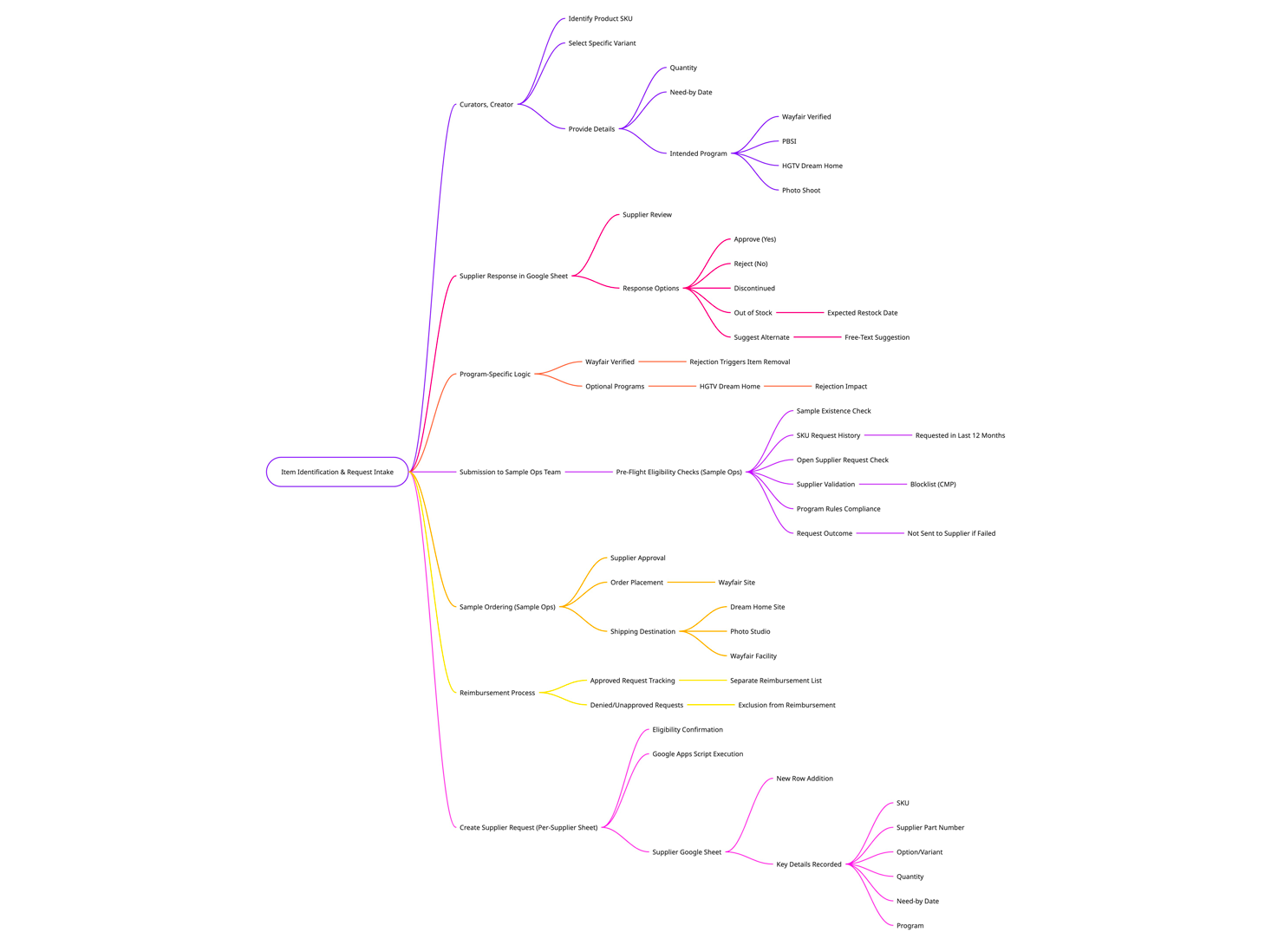
Historically these requests were managed manually using supplier spreadsheets, creating fragmented workflows and operational inefficiencies.
A Fragmented Experience
Manual Spreadsheets
Thousands of supplier spreadsheets were used to manage sample requests, creating fragmented workflows across teams.
Operational Bottlenecks
Merchant operations teams manually validated every request before sending it to suppliers, slowing down the entire process.
Limited Visibility
Merchants could not track request status or supplier responses in one unified system.
Workflow Mapping
Understanding the complex handoffs between stakeholders revealed critical friction points in the sample request lifecycle.
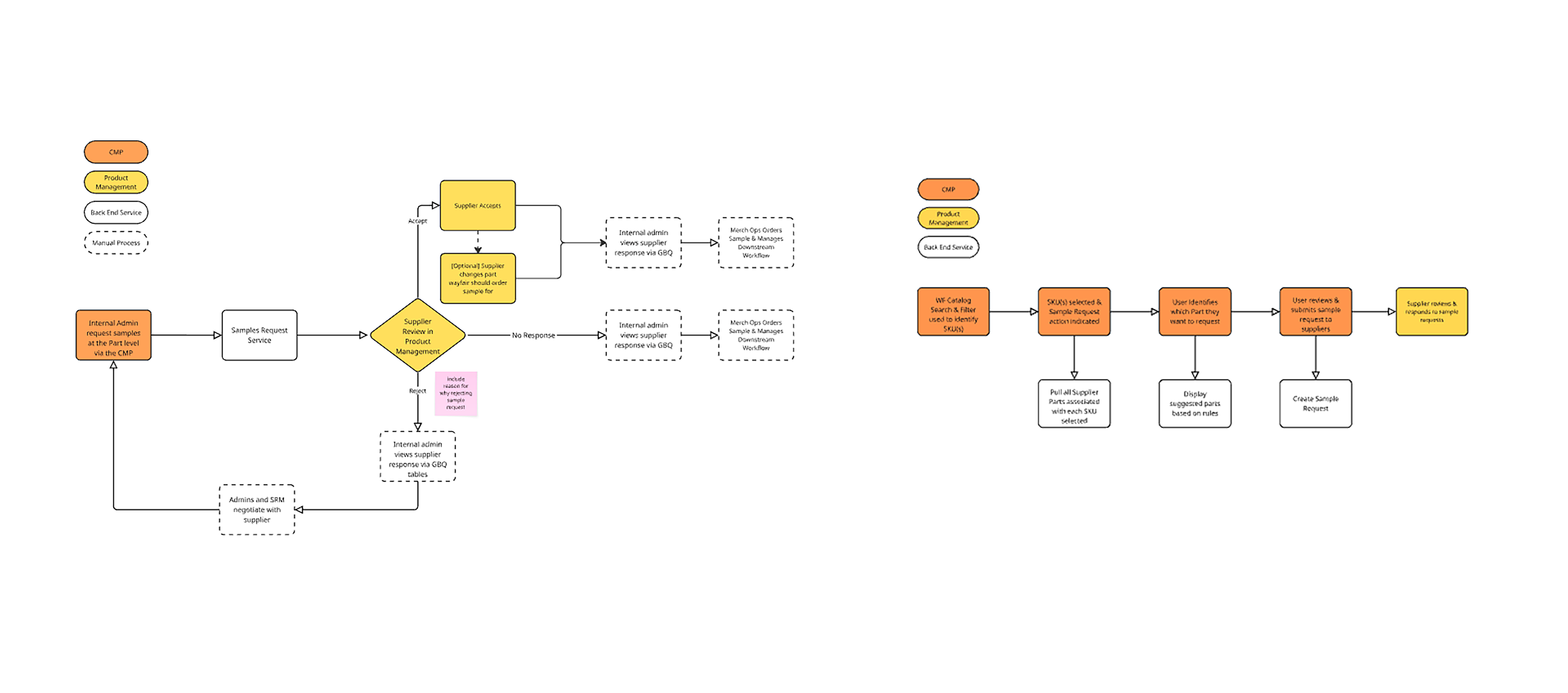
Merchants
Request samples
Sample Operations
Validate requests
Suppliers
Fulfill requests
Key Insights
I conducted primary interviews with merchants and key internal stakeholders to gain more insights into the pain points.
Merchants want to see all product variants before requesting samples.
System recommendations improve speed and reduce decision fatigue.
Large batch requests require a safety checkpoint.
Merchants think in products but requests occur at the variant level.
Design Challenges
Batch Scale
Handling batch requests up to 500 SKUs without overwhelming the interface
Mental Model Gap
Bridging SKU-level thinking with variant-level requests seamlessly
System Integration
Integrating with existing merchandising workflows and tools
Understanding the UX Challenge
This project required redesigning a complex workflow that connects merchants, suppliers, and internal operations teams across multiple product states and object levels.
The challenge was not just building a new interface, it was designing how users interact with a system of interconnected product entities.
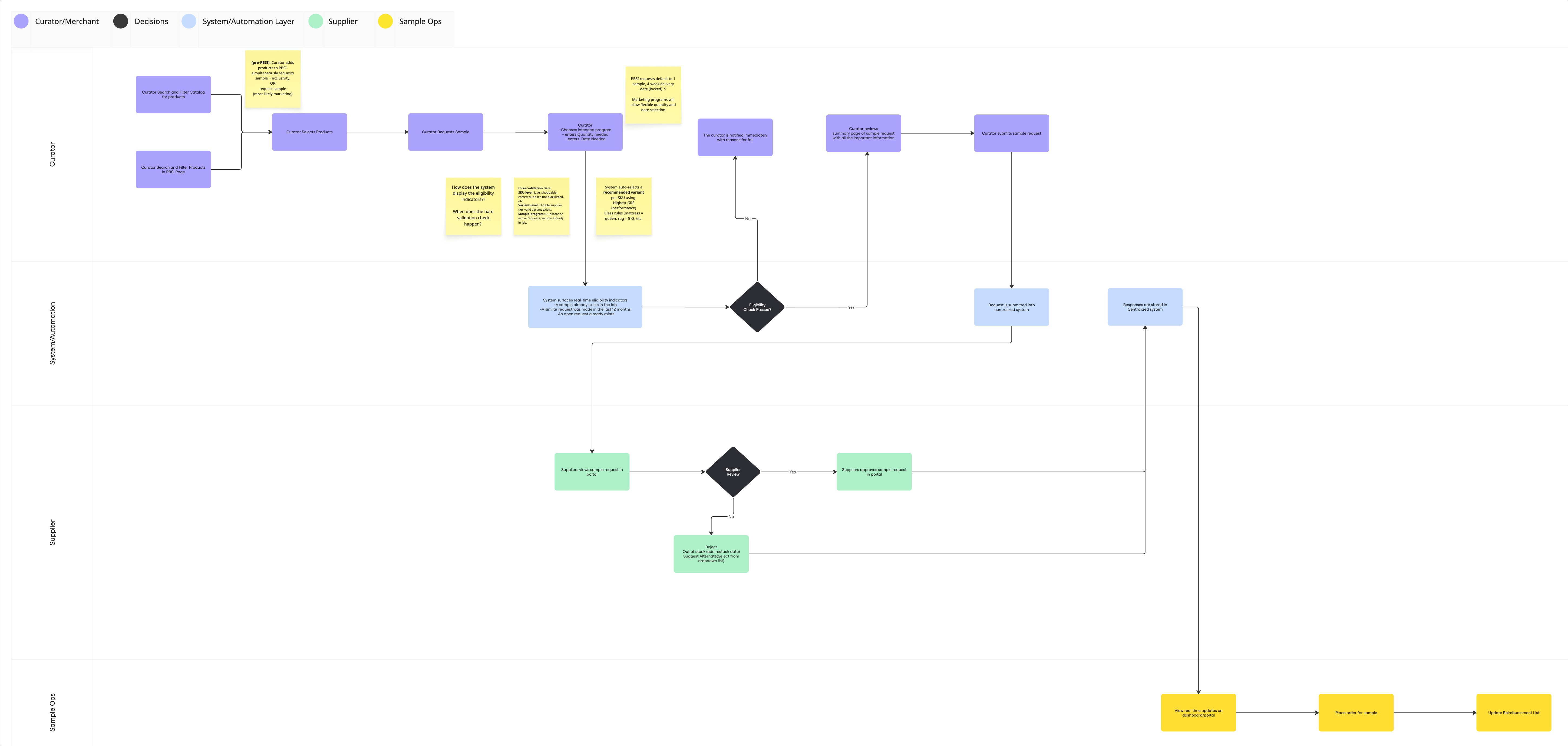
Merchants browse supplier catalogs to identify products with strong revenue potential.
Once a product is selected, merchants send an exclusivity request to suppliers. Approved products enter the PBSI assortment, a curated set of strategic items.
From there, merchants can request physical samples so that operations teams can validate product quality before the item becomes eligible for campaigns, retail placement, and verified product status.
Although the workflow appears linear, it actually spans multiple teams, systems, and approval stages, creating significant UX complexity.
Object-Oriented Complexity
The core UX challenge came from the hierarchical nature of product objects.
Merchants typically begin workflows at the listing or collection level, but the operational process for requesting samples must occur at the variant level.
This means users must transition between different product entities during a single workflow, while maintaining context across hundreds of items.
Additionally, products can enter the workflow from multiple entry points, such as the supplier catalog or the PBSI assortment workspace. Each product also carries a lifecycle state, such as not curated, awaiting exclusivity approval, sample requested, or inspection completed, which determines the actions available to the user.
Designing the experience required building a system that preserved the relationships between these objects while guiding users through a complex, multi-step operational process.
“The hardest part of this project was designing for object transitions, not screen transitions.”
Users were not simply completing a form.
They were navigating across collections, product listings, variants, and supplier approvals, each with different validation rules, states, and operational dependencies.
The design solution needed to reduce cognitive load while keeping users oriented within a highly interconnected product system.
Streamlined Workflow
A step-by-step process with automated validation and centralized tracking.
Select SKUs
Choose products for sampling
Review Supplier Parts
Examine available variants
Validate Eligibility
Automated requirement checks
Submit Request
Confirm and send to supplier
Supplier Responds
Track in Partner Home
Key Features
Exploded Variant View
See all product variants at a glance before making sample requests, reducing back-and-forth with suppliers and speeding up decision-making.
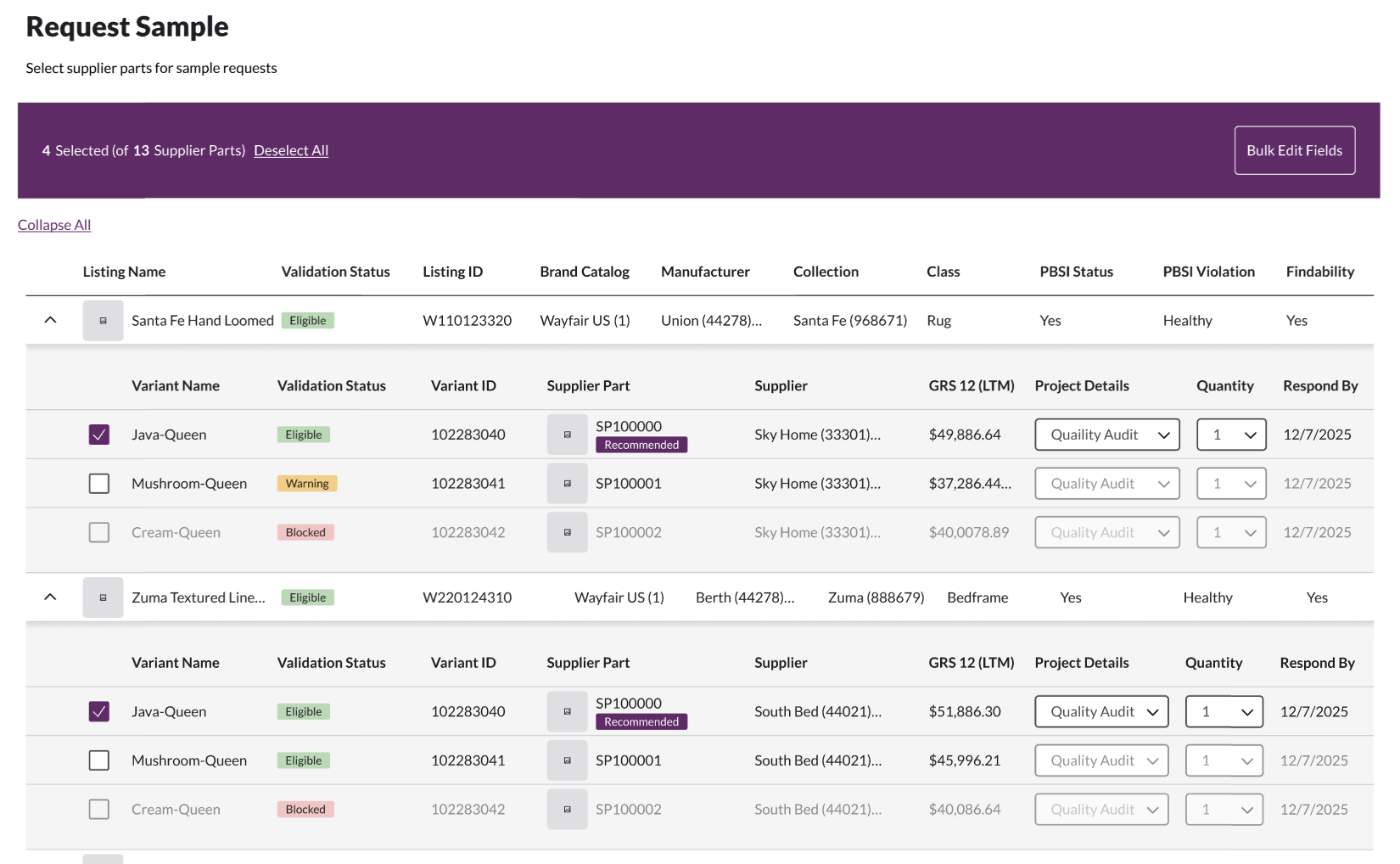
Intelligent Recommendations
AI-powered suggestions based on historical data and product performance metrics help merchants make faster, more informed decisions.
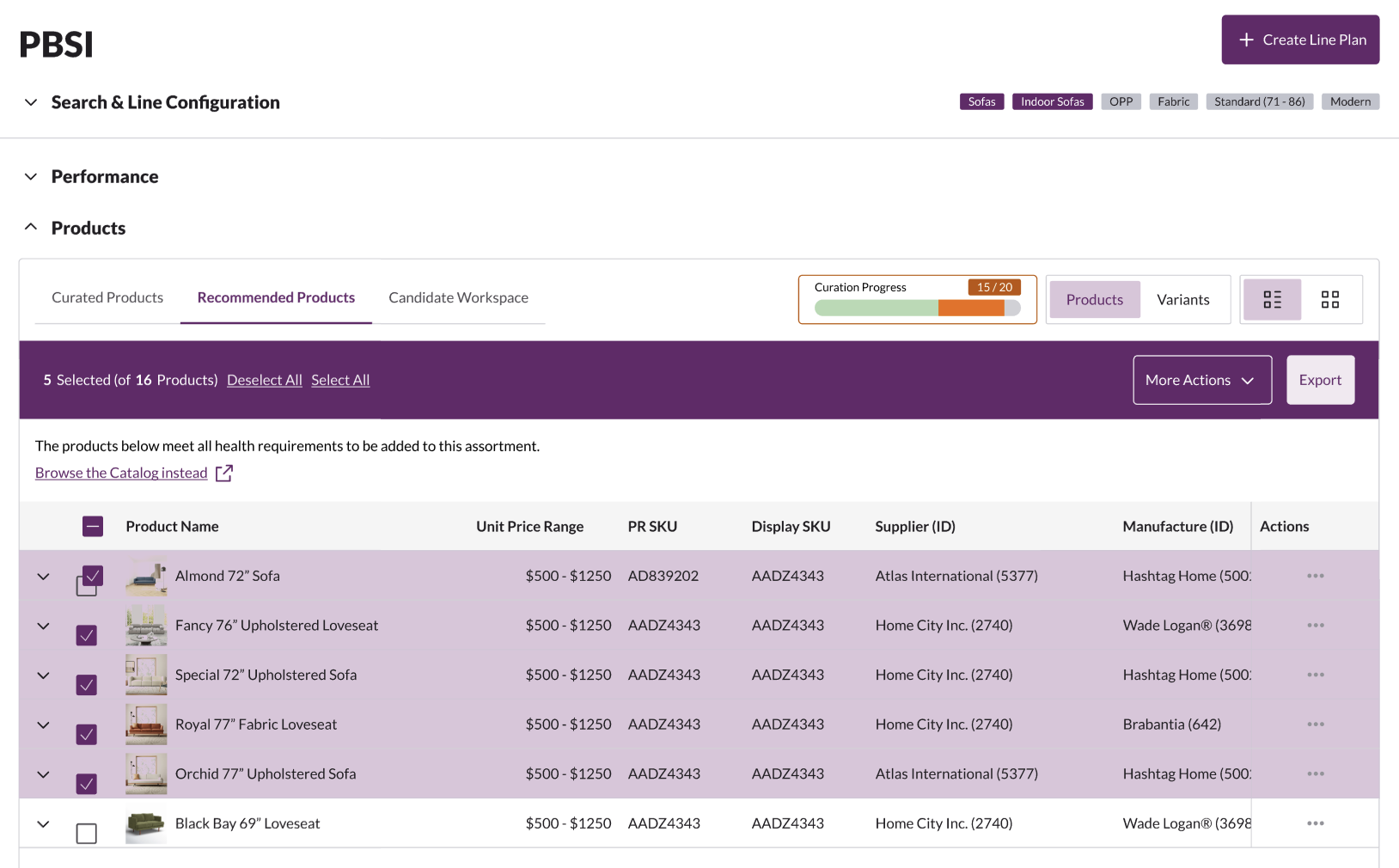
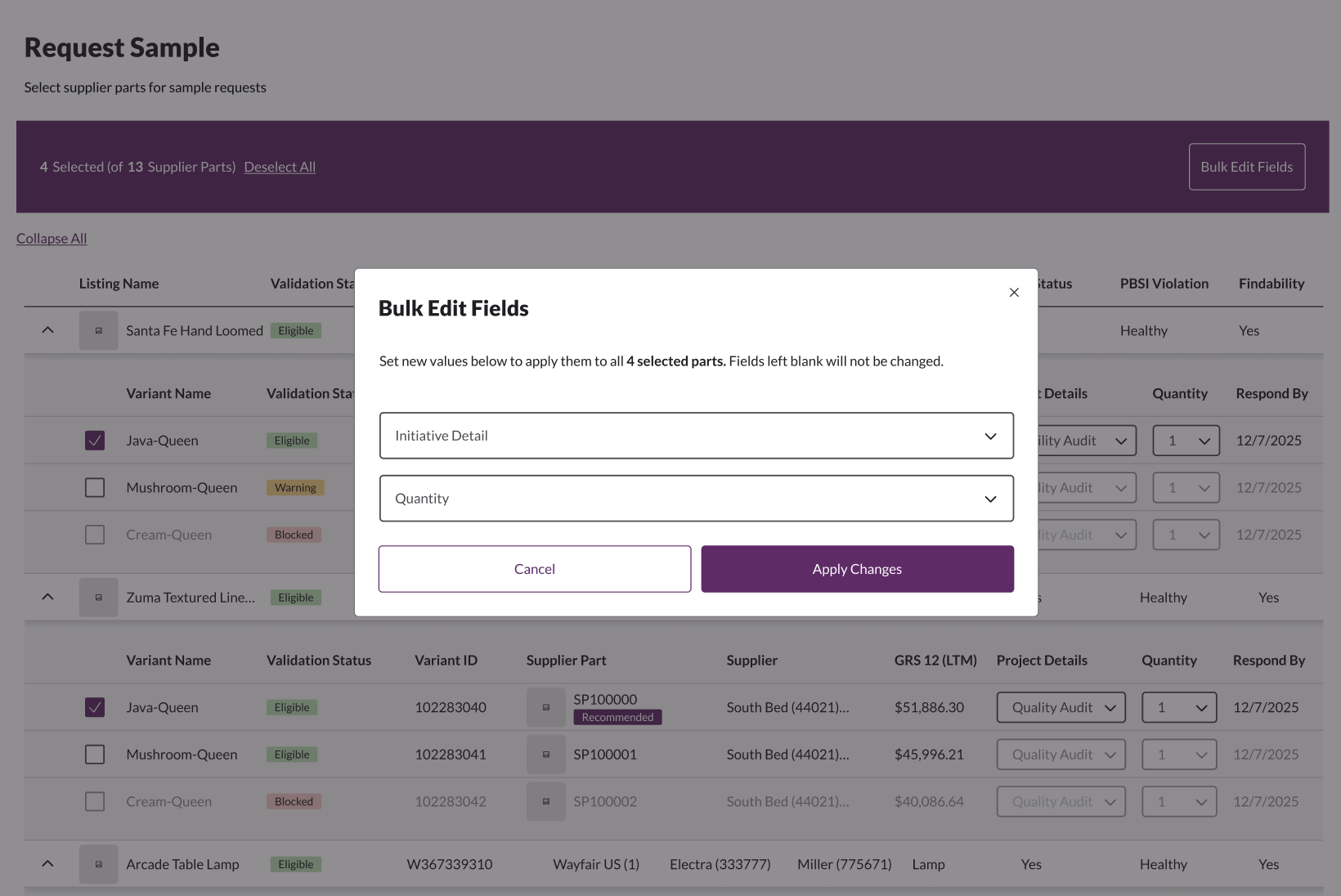
Bulk Editing
Select and modify multiple SKUs simultaneously, handling batch requests up to 500 items with ease.
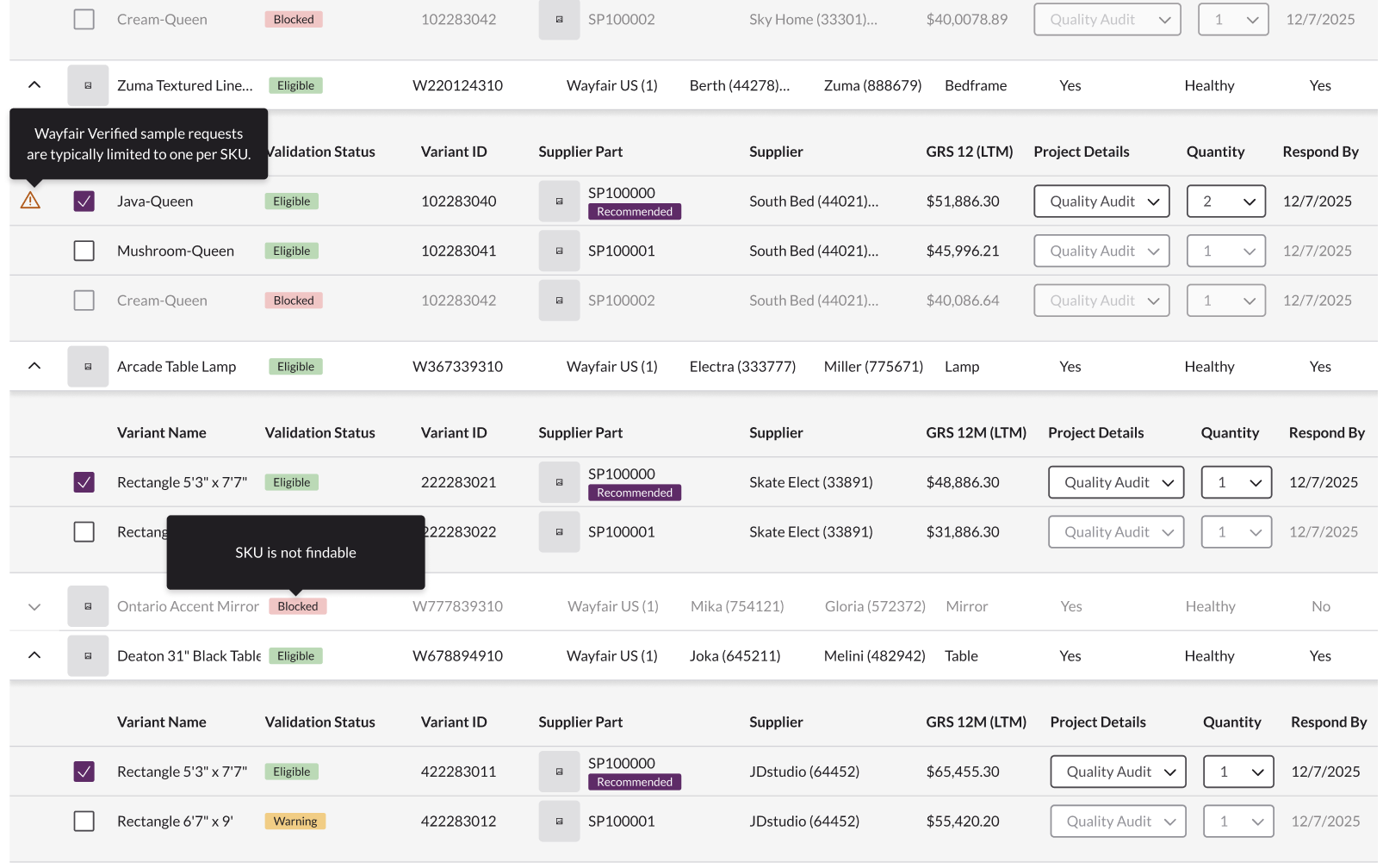
Real-Time Validation
Instant eligibility checks with clear feedback on request status and requirements, eliminating manual validation steps.
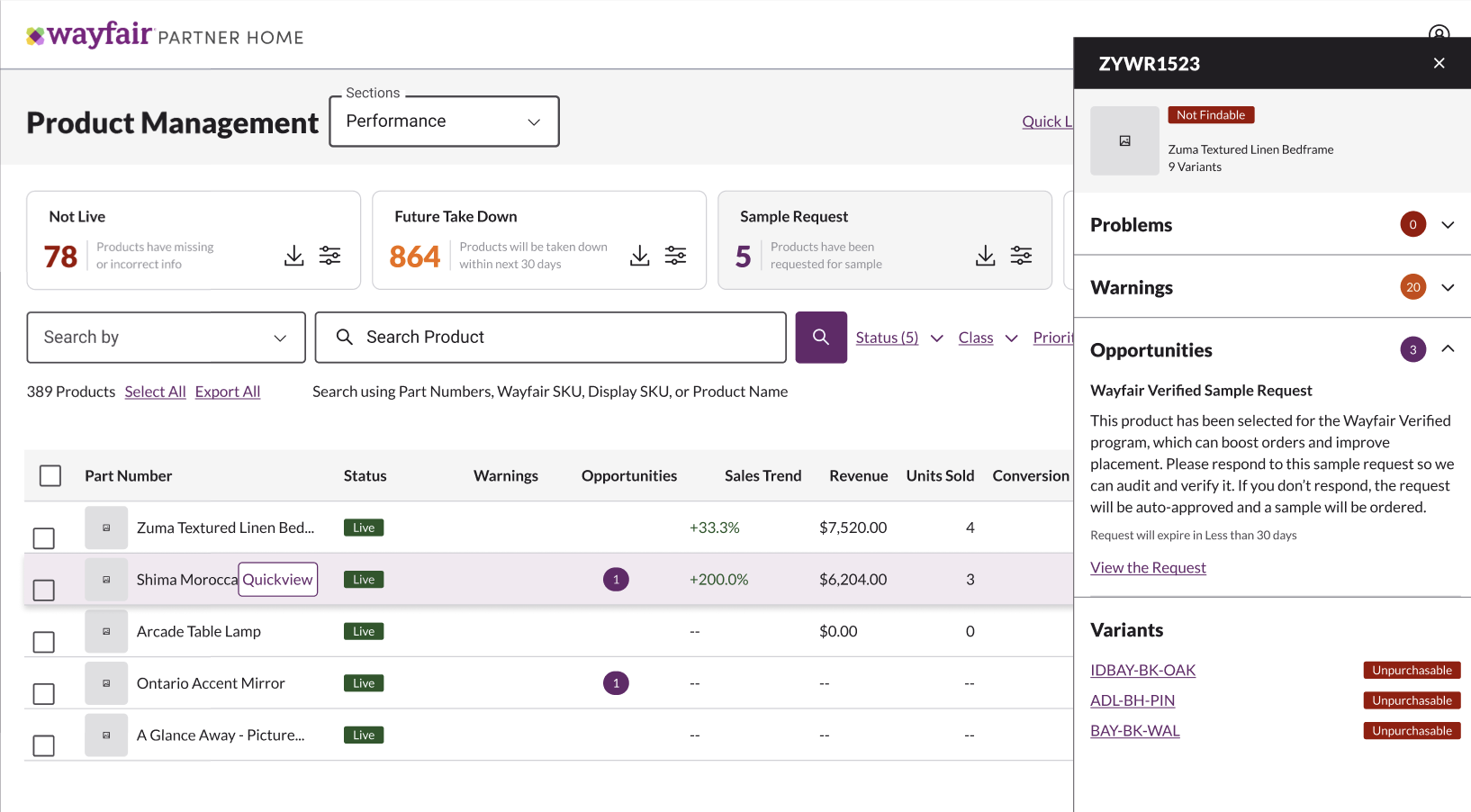
View Sample Request UPL
Suppliers can easily filter their Unified Product Listing (UPL) and view the sample request for approval.
Measurable Results
100%
Centralized sample requests
1000+
Spreadsheets eliminated
Auto
Validation automated
500
Max bulk SKUs supported
Lessons Learned
Designing internal tools requires optimizing for efficiency rather than simplicity, power users need depth, not handholding.
Systems thinking is essential when workflows span multiple product hierarchies and team boundaries.
User testing challenged assumptions about information density, merchants wanted more data, not less.
Prototype Walkthrough
A walkthrough demonstrating the end-to-end merchant experience for requesting product samples across multiple SKUs.
Future Opportunities
Next Project
Unified Campaign Creation
Redesigning the campaign creation workflow for suppliers to launch sponsored product campaigns.